
In Over His Head (The $64B Question: ‘How’d He Get There?’)
At least to me, the truly provocative question about former Treasury Secretary and New York Federal Reserve President Tim  Geithner isn’t what was going on at the senior-most levels of government during the height (depth?) of The 2008 Financial Crash (sorry, “Great Recession” is a red herring).
Nor is it what Geithner was privately thinking as the Government reeled from one disaster (Bear Stearns) to another (Lehman Bros, AIG, Fannie Mae, Freddie Mac), confronting the real risk of imminent, financial melt-down.
Rather, it’s what a neophyte and financial lightweight like Geithner was doing in the middle of it all.
“A for Effort” — But Too-Thin Resumé
The picture that emerges in Michael Lewis’ review of “Stress Test,” Geithner’s account of that period, is of an earnest and even sympathetic civil servant.
As Lewis freely allows, “I doubt many readers will put Geithner’s book down and think the man did anything but his best.”
Unfortunately, it’s dubious whether Geithner’s best was good enough.
The portrait Lewis draws isn’t especially kind:
“In general, Geithner comes across as the sort of young person who had no particular idea of himself until the world forced him to have one. His lack of a need for self-definition ” hinting at an unusual capacity, perhaps, to live with uncertainty ” extended to his career. He apparently didn’t feel much personal ambition, at least in the beginning. Oddly, for a Republican Ivy League graduate of the 1980s ” and even more oddly for a future Treasury secretary ” he found Wall Street pointless and the business world faintly ridiculous. He had no particular interest in money. “I did endure one job interview with a management consultant, whose first question was about how I would turn around a small failing beer company,” he writes. “I had no idea.”
–“The Hot Seat”; New York Times Sunday Book Review (May 15, 2014)
Lewis’ underwhelming take on Geithner is hardly unique; James Freeman of The Wall Street Journal has an even dimmer view of Geithner’s qualifications:
“At the time Geithner became president of the New York Fed, he had never worked in finance or in any type of business ” unless one counts a short stint in Henry Kissinger’s consulting shop. At Dartmouth, Mr. Geithner “took just one economics class and found it especially dreary.”
–“The Man Who Knew Too Little”; The Wall Street Journal (May 11, 2014).
Puppy Dog vs. Guard Dog
All of which begs the original question: “so, exactly how did Geithner get to be where he was??”
Assuming it wasn’t simply an accident (and I don’t), I think the inescapable conclusion is that financial potentates like former Treasury Secretaries Robert Rubin and Larry Summers, and former Goldman Sachs CEO and Treasury Secretary Henry Paulson didn’t want a strong, independent voice in the room.
 Just imagine the fireworks if they’d had to persuade (former Fed Chair) Paul Volcker to sell TARP to Congress, or the American public.
Fat chance.
Rather, guys like Paulson wanted exactly what Geithner was: a dutiful protegé/lieutenant, who lacked the stature, knowledge, and temperament to push back on their initiatives.
By all indications, that’s exactly what they got.
P.S.: The ultimate cipher in high office?
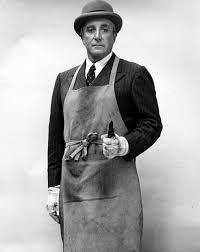
The fictional (fortunately) “Chance the Gardener,” from Jerzy Kosinski’s brilliant “Being There” (Peter Sellers — pictured above — played him in the movie).
