
Q: Do the Pages in a Real Estate Contract Have to Be Numbered?
I know that some fellow agents — and perhaps an Office Manager or two — may strenuously object.
 However, it’s my blog, and I am a former corporate attorney.
So, here’s the answer: ‘no, they don’t.’
Rationale
I’ll go even further: not only does a valid, legally enforceable real estate contract not need to have numbered pages, but it doesn’t have to be typed, in black ink, a certain font, include standard clauses . . . or really anything that most laypeople associate with a formal contract.
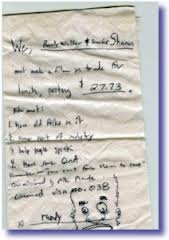
Yup, that’s right: if two willing, competent adults wanted to enter into a valid, binding real estate transaction in crayon on the back of an envelope (or napkin!) — they could.
To be valid, a binding contract only must satisfy the requisites of “Offer,” “Acceptance,” “Consideration,” and “Legal Subject Matter.”
The parties to a contract must all be properly authorized and possess what’s called “legal capacity,” and to be enforceable, a contract conveying real estate must be in writing.
But numbered pages?
Not that I’m aware.
Practical Considerations
All that said, there are some practical considerations for assembling a residential real estate contract a certain way.
My preferred order, at least for a standard deal: 1) the Buyer’s earnest money check; 2) Counter-Offer; 3) Purchase Agreement; 4) Financing Addendum; 5) Inspection Addendum; 6) Arbitration Addendum; 7) Personal Property Addendum; 8) Minnesota Seller’s Disclosure (including the Radon Supplement); and 9) Lead-Based Paint Addendum.
 Total number of pages associated with the foregoing: about two dozen.
The reason I draft a contract with the foregoing constituent pieces, in that order, is both because that’s what other Realtors are familiar with, and because doing so serves as a sort of mental checklist, ensuring that you’ve covered all bases.
However, especially because a good convention is to add the most recent, superseding documents (like the Counter-Offer and any Addenda) to the top of the contract, I find that if you number the subordinate pages, you find yourself endlessly re-numbering them as the deal evolves.
See also, “Deals on the Back of an Envelope . . . & Written Statements via Text Message“; “Why I Don’t Number Pages in Purchase Agreements“; “Minnesota Realtors and the ‘Unauthorized Practice Law‘”; and “Legal Drafting Tips for Realtors.”
P.S.: Another helpful drafting aid is this one, via journalism: ask yourself, does this contract address “Who, What, Why, When, Where, and How?”
Writers will recognize this mantra as “the 5 W’s (and an “H”).”
